
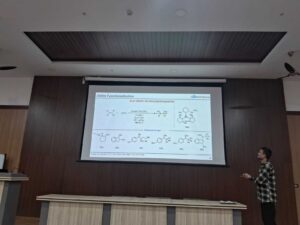
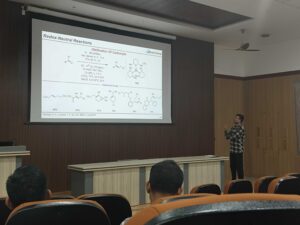
Mukul presented his Graduate Colloquium on the topic entitled as Organic synthesis via electrophotocatalysis. A short description of his talk is given below.
Kolbe electrolysis has been known for a long time, but over the past three decades many research groups have begun using electricity as a reagent, as it is cheap and traceless, serving as both a source and sink of electrons. At the same time, another rapidly growing field involves the use of light in chemical transformations, known as photocatalysis.
Electrocatalysis and photocatalysis have been the focus of extensive research efforts in organic synthesis over the past decades, yielding a wide array of powerful methods for the construction of complex molecules. Despite this progress, the combined use of these two modalities has only recently attracted significant attention. Research in this emerging area has enabled new strategies for C–H functionalization, reductive cross-coupling, olefin addition, and related transformations.
Electrophotocatalysis uniquely merges the energy input of light with applied electric potential, allowing access to previously inaccessible reactivity through single-electron transfer (SET) processes.
Research into combining these two approaches—known as electrophotocatalysis (EPC)—was almost non-existent until recently. In the past five years, however, interest in EPC has grown rapidly. By using both light and electrical potential, EPC has created new tools for chemical synthesis. This combination brings both the advantages and the difficulties of photocatalysis and electrocatalysis, but it also offers the possibility of new and unique chemical reactions that arise from using the two together.
This talk was a detail conceptual travel through a selected few examples of electrophotocatalytic methodology and also how to make such reactions streamline.