
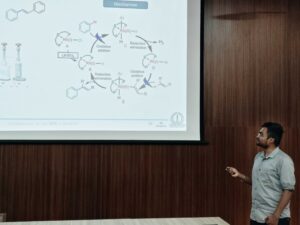
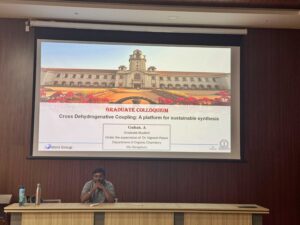
Guhan presented his Graduate Colloquium on the topic entitled as “Cross Dehydrogenative Coupling: A platform for sustainable synthesis” a concise overview of his talk is given below.
Cross dehydrogenative coupling (CDC) has emerged as an important conceptual strategy in modern organic synthesis, reflecting the continuous drive toward more efficient and streamlined chemical transformations. By enabling the direct formation of bonds through C–H activation, CDC embodies the principles of step economy and operational simplicity, making it a highly attractive method for constructing structurally diverse molecules. Over the years, the field has expanded significantly, with a wide range of catalytic systems now available to facilitate diverse bond-forming processes. As a result, CDC has established itself as one of the most versatile and powerful approaches for the synthesis of complex molecular architectures.
His presentation provided a broad overview of cross dehydrogenative coupling, highlighting its conceptual foundations, overall significance, and increasing impact on modern organic synthesis and also explored the reasons behind the sustained interest in CDC as a dynamic