
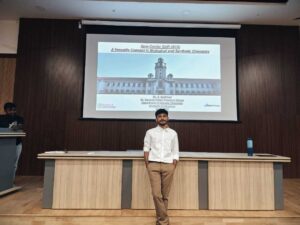
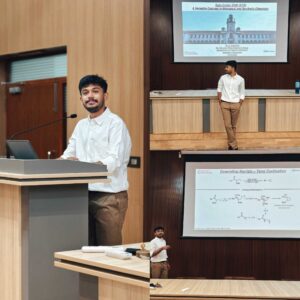
A short description of his talk is given below
Spin-center shift (SCS) emerged as a powerful conceptual strategy in radical chemistry that has significantly expanded the strategic toolbox of modern organic synthesis by reflecting the growing emphasis on selective and efficient molecular transformations. It refers to the translocation of a radical center accompanied by a two-electron bond reorganization, typically involving heteroatoms. Recent advancements highlight spin-center shift (SCS) as an efficient approach for reorganizing molecular frameworks through radical intermediates. By enabling the migration of radical centers through simultaneous bond reorganization, SCS provides a unique pathway for the activation and functionalization of otherwise inert chemical bonds. Unlike conventional radical reactions, this strategy enables positional transfer of reactivity within a molecule, allowing chemists to redesign bond connectivity with greater precision. Overall, spin-center shift represents a powerful paradigm in radical-mediated synthesis, offering new opportunities for efficient and selective molecular design. Continued research in this area is expected to further unlock new reactivity patterns, particularly in sustainable and site-selective organic synthesis. This presentation highlights the key principles and discusses recent developments accomplished using spin center shift to shape the future of radical-mediated transformations.