
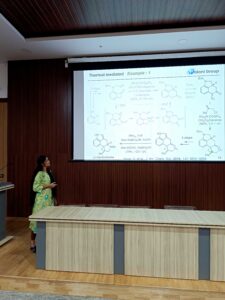
Devagi has presented her Graduate Colloquium on the topic Transition-metal-enabled C-C sigma bond cleavage: Streamlining synthetic efforts toward natural product synthesis. A short description about her topic is given below.
Achieving an elegant synthesis of a natural product serves as an engine for discovering its bioactivity. In particular, including modularity in a total synthesis would streamline the preparation of a library of analogues that could potentially deduce the structural component behind the observed bioactivity through a series of well-planned structure-activity relationship (SAR) studies. This, in turn, could facilitate the discovery of more potent therapeutic drugs. The ‘C–C’ sigma bond is one of the most predominant bonds in organic molecules after C–H bonds. Activating a C–C selectively would enable rapid construction of molecular complexity. However, this has been challenging considering the C–C bonds’ thermodynamic stability. With the rapid progression in organometallic chemistry, significant attention was brought to enabling activation of C–C sigma bonds by employing a suitable transition metal. This notable direction paved the way for the development of unique retrosynthetic disconnections, facilitating the construction of organic molecules in various interesting ways. Notably, achieving the total synthesis by cleverly leveraging the C–C sigma bond activation/cleavage with appropriate stereo and regio-selectivity constraints has garnered significant attention over the years. This talk will detail a conceptual travel through a selected few transition metal mediated C–C sigma bond cleavage methodologies and how incorporating such reactions streamlined the total synthesis of natural products.